 Mineforgian
Solstice
A Minecraft shader pack that balances stunning visuals and smooth performance.
- Загрузки
- 2K
- Подписчики
- 3
- Обновлён
- 30 июля 2026 г.
- Лицензия
- Custom
Опубликован 3 июля 2026 г.
Solstice v1.5
Thank you for 4,000 downloads! (on curseforge, but also thank you for 2k downloads on Modrinth!!)
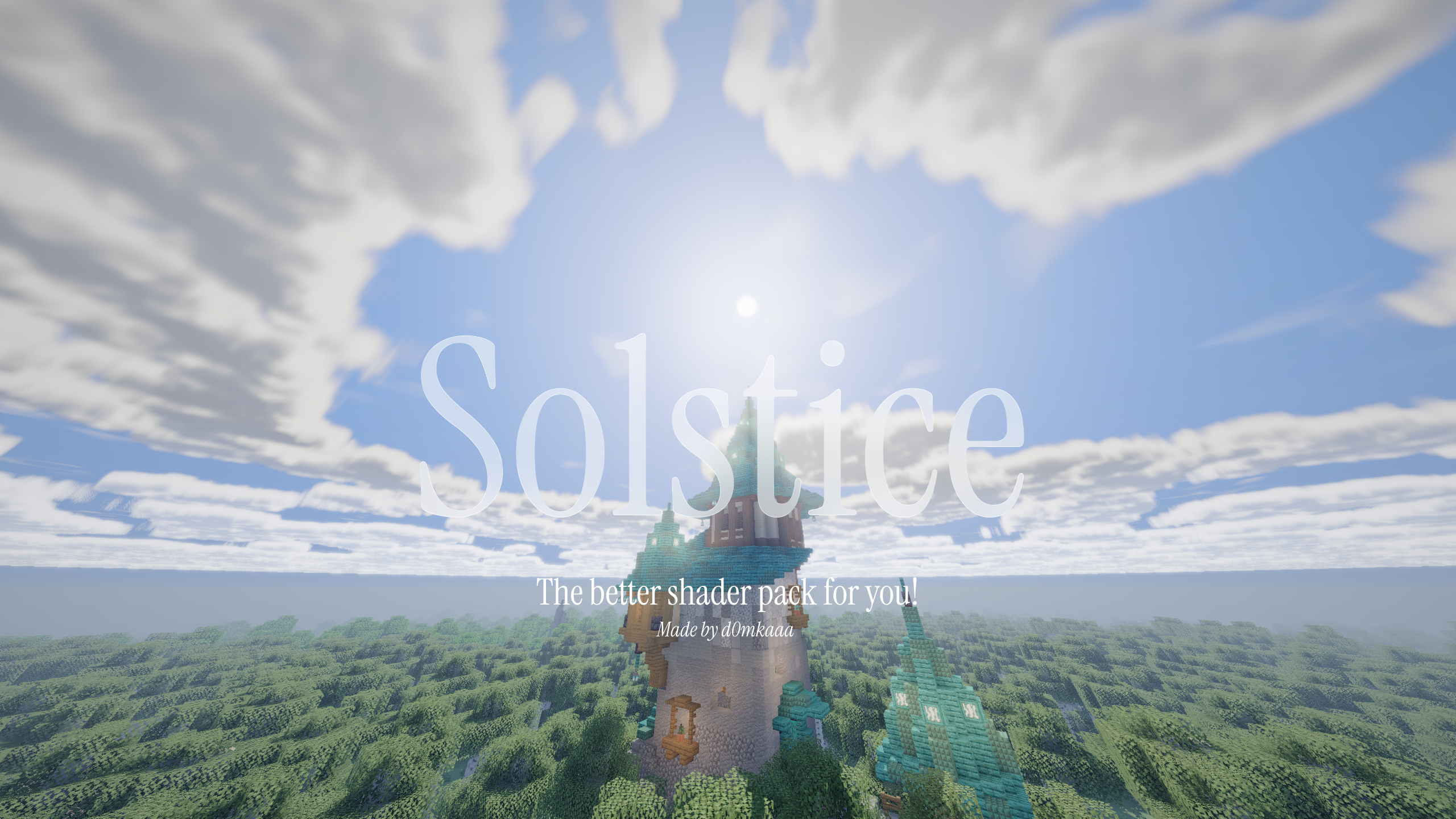
Solstice is a semi-realistic Minecraft shader with adjustable effects and four performance profiles. It is developed on an RX 6600 at 1440p.
Features
- Soft shadows, moving foliage, coloured glass shadows, and underwater caustics.
- Blocky 3D or volumetric clouds with cloud shadows and changing weather.
- Reflective water, waves, rain ripples, underwater fog, and god rays.
- Rain puddles, glowing blocks, portal light, snow sparkle, and animated flames.
- A circular sun and moon, stars, meteors, the Milky Way, and occasional auroras.
- Built-in materials for some vanilla metals and polished blocks.
- LabPBR 1.3 normal, material, AO, and emissive map support.
- Distant Horizons terrain and water support in the Overworld, Nether, and End.
- Bloom, FXAA, colour grading, optional sharpening, and contact shadows.
- Separate Survival, Balanced, and Builder lighting styles.
Install
- Install Iris on Fabric. Iris is already included with Fabulously Optimized.
- Put Solstice in the Minecraft
shaderpacksfolder. - Select it under Video Settings → Shader Packs.
- Start with the Medium profile.
Profiles
- Low: blocky clouds, basic shadows, and most expensive effects disabled.
- Medium: the normal gameplay preset. Volumetric clouds, materials, bloom, puddles, god rays, and balanced shadows.
- High: better shadows and clouds, SSAO, and screen-space reflections.
- Ultra: maximum cloud and shadow quality. Mainly intended for screenshots or fast GPUs.
Lighting Style and colour settings are separate from the performance profile.
Settings to try
- Lighting Style: Survival is darkest, Balanced is the default, and Builder brightens interiors.
- Cloud Mode: choose Blocky 3D, Volumetric, or Off.
- Material Source: choose built-in materials or a LabPBR resource pack.
- Material Reflections: Off, Sky Only, or SSR.
- Fog Density: controls distance fog and can be set to zero.
- Water Murkiness: controls underwater visibility.
- Colour Grade: Natural, Vivid, or Classic.
Distant Horizons
Solstice supplies its own LOD fog and side lighting. Recommended DH settings:
- LOD Fog: Off
- LOD Side Shading: Off
- Cave Culling: On, height around
60 - Overdraw Prevention:
100% - Max Horizontal Resolution: Block
- Horizontal and Vertical Quality: High for normal play
DH shadows are disabled because Iris may render the whole LOD range into the shadow map. Normal distant terrain and water are still shaded.
LabPBR
Built-in materials work with vanilla textures, but the effect is subtle. For visible normal maps and authored material detail:
- Install a LabPBR 1.3 resource pack.
- Enable Materials.
- Set Material Source to LabPBR Resource Pack.
- Set Material Reflections to SSR.
Check brick, cobblestone, polished stone, quartz, iron, gold, or copper in angled sunlight. Height-map parallax is not supported yet.
Performance
If the shader is too slow, lower these settings in order:
- Shadow Resolution
- Shadow Distance
- Shadow Filter Quality
- Cloud Quality
- SSR Quality, SSAO, or material reflections
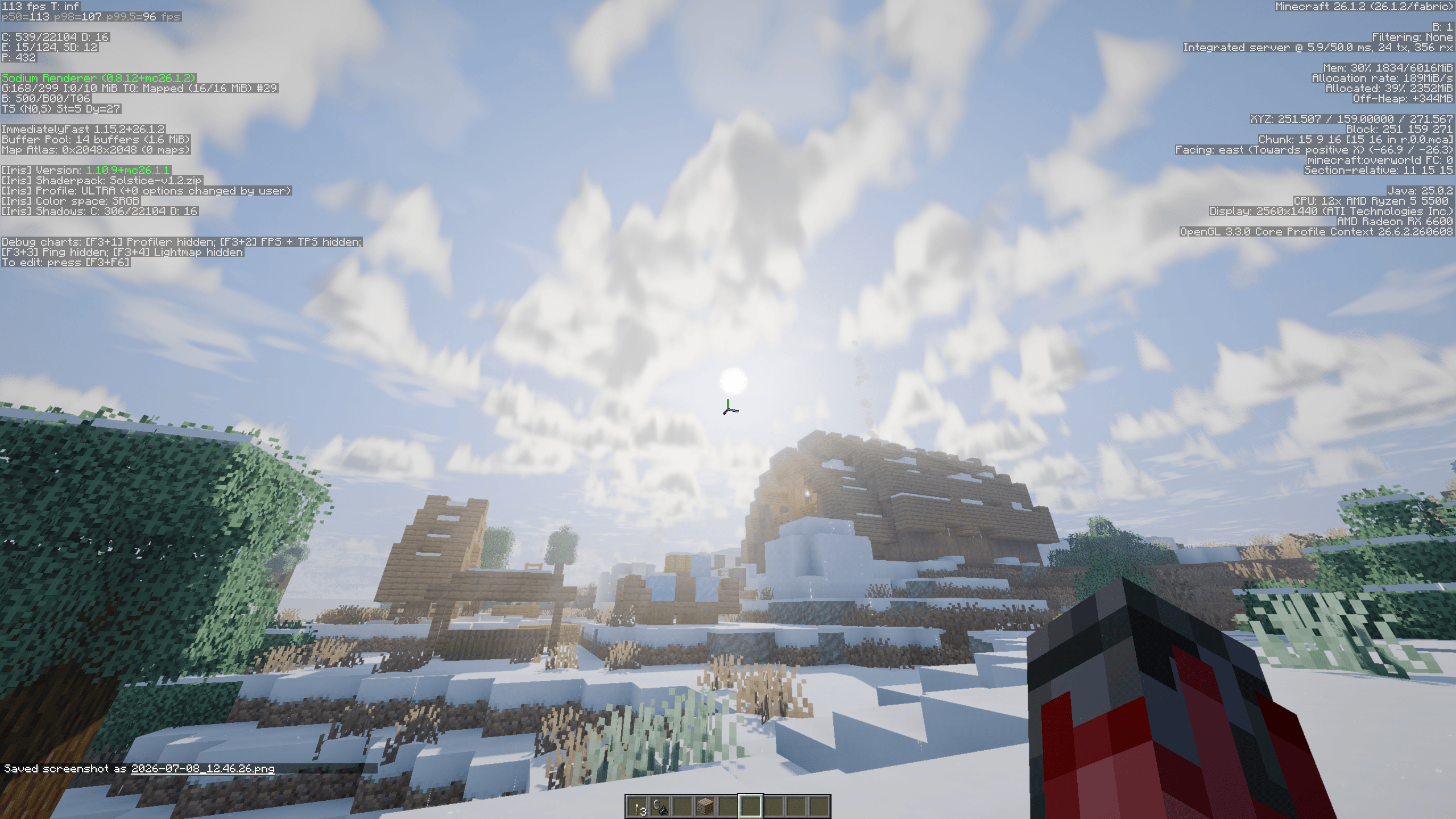
Captured with Ultra on Minecraft 26.1. Results depend on the GPU, resolution, world, mods, and render distance.
Common problems
- Bright or dark DH seam: disable DH LOD Fog and LOD Side Shading.
- Underground LOD terrain is visible: enable Cave Culling and set Overdraw Prevention
to
100%. - Materials look unchanged: use a LabPBR 1.3 pack and select it as the Material Source.
- Shader compilation fails: send the full Iris error together with the Minecraft, Iris, DH, GPU, and driver versions.
See CHANGELOG.md for the full version history.
Author
d0mkaaa (Domantas)
Ченджлог
1.5Релиз26.1.1, 26.1.2, 26.2 · 30 июля 2026 г.
v1.5
Materials alpha
- Added a shared lightweight material library with LabPBR 1.3 normal, AO, perceptual smoothness, F0/metal, and emissive decoding; absent maps retain a neutral matte fallback
- Added Natural and Pronounced built-in material styles; the stronger choice only changes generated vanilla metal/polished smoothness and never alters LabPBR resource-pack data
- Terrain, entities, and the hand/held-item pass now use tangent-space normals and an inexpensive GGX/Smith/Schlick direct response without replacing the existing lighting model
- Extended the material path to translucent water and glass: genuine resource-pack normal detail can perturb procedural water without flattening absent-map waves, while glass reads LabPBR normal, AO, F0, smoothness, and emission channels
- Added conservative built-in metal and polished-mineral classes for vanilla textures; ordinary stone, wood, soil, and foliage deliberately remain matte
- Reused
colortex3for opaque material normals/reflection strength, with separate class ranges for opaque materials, portals, puddles, and water - Added Off / Sky Only / SSR material reflection tiers and profile defaults: Low compiles materials out, Medium uses sky reflections, and High/Ultra permit material SSR
- Added a dedicated Materials options page with Built-in / LabPBR Resource Pack source and specular-strength controls
Distant Horizons
- Added dedicated compatibility-profile
dh_terrain,dh_water, and future-readydh_shadowprograms for the Overworld, Nether, and End - DH terrain reuses Solstice's sky light, block light, weather color, cloud shadows, foliage response, emissive classification, and dimension lighting
- Added distance-filtered world-space material detail for grass/leaves, stone, deepslate, wood, dirt, sand, snow, terracotta, Nether stone, metal, and lava; this restores surface breakup where Iris cannot expose block-atlas UVs to the DH shader path
- Corrected DH grass blocks being treated as translucent foliage and metal being treated as emissive; metal now receives a restrained broad highlight instead
- DH water uses biome color, Solstice's user water tint, distance-stable waves, physical Fresnel, sky reflections, light glints, and transparent blending
- Native and DH depth now share one scene-classification/reconstruction helper
- Atmospheric fog preserves the native look near the player, thins beyond the native horizon for readable vistas, and dissolves only at the outer DH render edge
- Clear-weather DH atmosphere was opened further so distant landforms retain colour and contrast; rain, thunder, dawn mist, and dimension atmosphere remain denser
- Added a defensive Overworld cave-face rejection for fully enclosed DH geometry below sea level, preventing stale cave LODs from leaking through the native/DH handoff
- Very distant DH color now receives restrained aerial chroma/contrast compression, reducing fluorescent repeated color across large LOD triangles
- Clouds and half-resolution reconstruction no longer mistake LOD silhouettes for sky
- Light-shaft occlusion, underwater absorption, and native-water SSR now see DH geometry
- Sun glare now uses a soft 16-point visibility probe plus angular broad/core response, so terrain occlusion and crossing the player's FOV edge fade continuously instead of switching the effect off
- SSAO, puddle metadata, and material-style surface effects remain native-only, avoiding wasted work and false seams on low-detail LOD meshes
- DH shadows are deliberately disabled until their all-LOD pass meets the performance budget; the depth-only program is present for future profiling
- Base rendering remains guarded by Iris's
DISTANT_HORIZONSfeature macro, preserving the existing non-DH path
Weather and color
- Volumetric cloud bodies now combine vertically decorrelated erosion fields with flatter bases, taller coverage-driven tops, and billowed internal density instead of extruding one 2D weather shape through the entire layer
- Reduced first-hit cloud extinction so the march reveals multiple illuminated density layers; High and Ultra add a second long-range sunlight probe, while clear-sky bounce and an inexpensive multiple-scattering floor keep shadowed daytime lobes blue-white rather than charcoal without brightening storm clouds
- Underwater sky rays now use solid depth behind the water surface to generate and merge the same cloud layer seen above water; water extinction and the Snell window attenuate that layer afterwards, so submerged views can no longer reveal a cloud-covered moon
- The shared sun/moon visibility probe now multiplies terrain visibility by resolved cloud transmittance, keeping celestial discs, halos, glare, and light shafts consistent
- Rebuilt shooting stars as sub-second meteors with a compact warm head, narrow tapered blue-white plasma trail, breakup flicker, and one shared life envelope; the old multi-second moving glow segment and lingering-looking smear are gone
- Stars, meteors, moonlight, and the lunar halo now use the smoothed weather state, preventing celestial clarity from snapping ahead of cloud recovery after rain
- Rain atmosphere now uses an Iris-smoothed weather state: storms close visibility quickly, while fog, cloud cover, lighting, reflections, and sun glare recover gradually for twelve seconds after rain instead of revealing the full DH landscape at once
- Rain/DH fog is substantially denser at long range, matching the short visibility expected from humid heavy weather while preserving nearby silhouettes
- Added Natural and Vivid color grades alongside the legacy Classic response; Natural is the new default and tone-maps luminance rather than RGB channels independently, preserving hue through highlights
- Natural grading applies restrained highlight/shadow chroma compression, gamut compression, and weather-aware white balance; default saturation is now neutral rather than boosted
- Cloud macro shaping no longer suppresses an enormous low-frequency region around the camera column, removing the persistent clear crater seen when looking straight upward
- DH water now rejects pixels covered by native opaque depth and fades in across the native water range, preventing ocean bands from drawing across portals, terrain, and builds
- Top-down DH water now matches native water's 2% normal-incidence Fresnel, body tint, and transparency instead of becoming a bright, highly reflective sheet
- Underwater extinction now follows the Water Murkiness setting for native and DH geometry; suspended-particle haze closes long-distance visibility, and the water surface softly limits the above-water scene to a physical Snell window instead of exposing the entire world
- The defensive DH cave filter now rejects fully enclosed zero-skylight Overworld LOD faces at any elevation, covering modded caves and incomplete world-generation columns
- Sunrise atmospheric color is now confined around the sun instead of reflecting as a straight neon horizon band; twilight cloud bodies stay neutral while their lit edges warm
Capture-driven performance
- Used an AMD RenderDoc counter capture to identify the full-resolution effect merge, volumetric clouds, final output, atmosphere/water, and AO mask as the meaningful Solstice post costs; the already inexpensive bloom and portal-blur passes were left unchanged
- Reworked cloud reconstruction to use its existing alpha coverage instead of rereading native and DH depth for every neighbouring half-resolution texel
- The final effect merge now builds half-resolution coordinates once and shares native depth samples between surface effects and light shafts, while underwater shafts continue using the solid depth hierarchy
- The merge reads the existing 1×1 celestial visibility result and skips all shaft-buffer reconstruction when the light source is off-screen, fully occluded, or otherwise inactive
- FXAA reuses the final pass's existing centre colour instead of sampling it twice at full resolution
- Volumetric cloud rays now hoist weather and lighting constants out of the density loop; primary density remains evaluated at every step while the smoother solar-occlusion probe is reused for one adjacent occupied step through the existing temporal reconstruction
- The terrain path now reuses its vertex distance and per-fragment direct-light colour, removing repeated length, celestial normalization, and weather-light calculations from the indexed chunk draws highlighted by the capture
Gameplay polish
- Added Survival, Balanced, and Builder lighting styles as a visual preference independent of Low/Medium/High/Ultra; the modes adjust night illumination, sky-light response, block light falloff, held light, and interior indirect floors without changing daytime exposure
- Renamed Night Darkness to Night Brightness so the slider direction is unambiguous
- Added optional low-strength contrast-adaptive sharpening after FXAA, with neighborhood clamping and flat-region rejection to restore texture clarity without strong sky noise or edge halos; underwater sharpening is skipped
Render paths and Minecraft 26.2
- Added explicit lightweight programs for damaged blocks, block entities,
translucent block entities, beacons, items, particles, translucent particles, translucent
entities, lightning/dragon beams, armor glint, emissive eyes, and translucent held objects
in the Overworld, Nether, and End; lines deliberately use Iris's documented
gbuffers_linetogbuffers_basicfallback - Translucent entity and block-entity passes retain forward lighting but no longer write
opaque material/SSR records into
colortex3 - Added
item.propertiesand separate main/off-hand light evaluation, allowing warm, soul-blue, redstone-red, amethyst/end-purple, and plant-orange held-light colors - Replaced hardcoded cutout thresholds with Iris's
alphaTestRefin terrain, entity, hand, generic textured, lit textured, shadow, and special overlay paths - Enabled Iris's separated translucent entity/block-entity draws and mixed particle ordering; beacon beams remain non-depth-writing so they cannot carve holes through fog
- Expanded current content metadata for Spring to Life foliage, golden dandelions, pale-garden plants and lights, trial spawners/vaults, copper bulbs, current emissive mobs, and the Minecraft 26.2 sulfur/cinnabar building families
1.4Релиз26.1.1, 26.1.2, 26.2 · 23 июля 2026 г.
v1.4
Reduced-resolution post pipeline
- Bloom moved from two full-resolution passes to quarter-resolution
colortex1/2, with a soft-knee threshold, firefly control, and a wider lower-intensity filter - Volumetric/blocky clouds, SSAO, and light shafts now render at half resolution
- The final effect merge performs depth/class-aware reconstruction so cloud, AO, portal, and shaft samples do not bleed across terrain silhouettes
- Disabled effects now disable their composite programs, including dimension-specific paths
Temporal skies and cloud lighting
- Volumetric clouds use a frame-varying march offset and a persistent cloud-only history
- History reprojects with the previous camera/model-view/projection data, clamps to the current 3x3 neighborhood, and rejects large camera jumps or reactive cloud changes
- Cloud direct light was rebalanced so the forward silver lining stays bright without turning the entire cloud body white; bases retain stronger tonal separation
- Full-scene TAA remains intentionally absent
AO, shafts, and portal light
- The repeated sun/moon visibility gather is now a single 1x1 frame-level pass
- Light shafts moved to a half-resolution buffer
- Full-resolution 16-tap portal gathers were replaced with a downsampled portal-light mask and two inexpensive separable blur passes
- SSAO moved from ten samples per full-resolution pixel to eight samples per half-resolution pixel
Reflections, shadows, and final image
SSR_QUALITYadds profile-controlled 16/24/40-step caps, matching refinement tiers, tighter hit thickness, Fresnel gating, and distance/travel rejectionSHADOW_FILTER_QUALITYadds 4/8/12-tap PCSS tiers; blocker samples scale with the tier- The shadow vertex pass reuses the visible terrain foliage deformation in player space
- The old four-neighbor edge blend was replaced with low-cost directional FXAA
- The filmic curve has a softer highlight shoulder and a gated near-black lift that leaves true black and genuinely dark caves anchored
1.3Релиз26.1.1, 26.1.2, 26.2 · 10 июля 2026 г.
v1.3
Reflections
- SSR rewritten as a screen-space march with perspective-correct depth interpolation (1/z is linear in screen space): every step lands on a fresh pixel, so distant reflections resolve crisply instead of skipping and smearing
- No matrix math inside the ray loop anymore as depth linearization is two fused ops, so the rewrite is both sharper and cheaper
- Step count adapts to the ray's on-screen length (14 to 40) to hit thickness scales with distance and validation is tighter, cutting ghost hits behind thin geometry
Clouds
- Volumetric cloud lighting now uses real scattering formulas: a dual-lobe Henyey-Greenstein phase function (the standard model for light in water droplets) gives a bright silver lining toward the sun and soft backscatter away from it, a two-term Beer transmittance approximates multiple scattering so cloud interiors stay luminous instead of going black, and a powder term darkens thin wispy edges
- Cloud bases sit darker and flatter (height gradient)
- Clouds drift about 4x slower and no longer morph constantly advect on the same wind vector, so a cloud moves as one body instead of its detail layers sliding at different speeds
- Fixed a profile bug: Medium, High and Ultra now explicitly select Volumetric cloud mode
- New Cloud Quality step 32; Ultra uses it
Light sources
- Block light (torches, lanterns, lamps) now follows the inverse-square law: the lightmap encodes distance to the source (vanilla light drops one level per block), so it gets remapped to real distance and attenuated with the same windowed inverse-square formula real renderers use for point lights. Light sources read as bright pools that fade fast, not an even wash
- Held-light uses the same attenuation
- Torch color documented as roughly a 1900K blackbody, matching real flame
- Realistic Light Falloff toggle under Visuals; the old curve remains as the off state
Glowing mobs & portal glow fix
- Blazes, magma cubes, glow squids and allays are now emissive: their bright texels glow and feed the bloom pass, under the same Glowing Blocks toggle
- Eye-glow mobs: enderman, spider, cave spider, phantom and guardian eyes emit with a high luma threshold, so the eyes burn in the dark while the body stays unlit - purple enderman eyes in a dark forest, red spider eyes in caves
- Removed the portal glow prefilter: its point-sampled early-out produced hard on/off boundaries (torn rectangular notches in the glow). The gather now always runs within range and is perfectly smooth
More real formulas & performance
- Water depth uses true Beer-Lambert absorption with per-channel coefficients: red is absorbed within meters, blue survives, so depth turns teal for the physical reason rather than a hand-picked fade color. Underwater fog uses the same law
- Purkinje shift: dark scenes drift toward desaturated blue-grey, matching how human rod vision behaves at night (toggle under Color & Tone)
- Depth unprojection in the composite exploits the projection's symmetric structure: five terms instead of a full matrix multiply, across every SSAO/SSR/glow sample
- The cloud march's sun-occlusion probe uses a cheaper 2-octave density (the light sample does not need full detail), cutting volumetric cloud cost by roughly a quarter
Shadows & block light polish
- Shadows upgraded to PCSS (percentage-closer soft shadows): a blocker search measures how far above the surface the caster sits, and the penumbra widens with that distance - the real behavior of sunlight as an area source. Shadows are contact-sharp at the base of a wall and progressively softer for tall trees. Fully lit pixels early-out after the 4-tap search, so most of the screen got cheaper while shadow edges got better
- The PCF disk is a noise-rotated Vogel spiral (8 taps) instead of a fixed 4-tap square, removing the boxy shadow edge
- Light patches projected through stained glass follow the same penumbra physics
- Block light falloff rebalanced: inverse-square core plus a cubic near-field term, because glowstone and lanterns are area sources with indirect bounce, not bare point lights
Water & portal polish
- Water fresnel replaced with true Schlick using water's physical F0 = 0.02 (from its refractive index): 2% reflection looking straight down so you see into the water, climbing to a near-total mirror at grazing angles
- Wave normals and rain ripples flatten with distance: far ripples are smaller than a pixel, so full-strength normals only produced aliasing speckle across the ocean
- Portal glow gather rebuilt as a Vogel spiral disk rotated by interleaved gradient noise: smooth pool of light with a soft edge instead of banded dither blotches, with a tighter radius and gentler intensity
Glass
- Stained glass throws vivid colored light: the tint that sunlight picks up passing through translucent blocks is now saturated, so a stained glass window paints strong colored patches on the floor behind it
- Windows catch the sky: glass gets a fresnel reflection of the sky gradient and a sun glint at grazing angles
- Glass Reflections toggle under Water options
1.2Релиз26.1.1, 26.1.2, 26.2 · 8 июля 2026 г.
Solstice Changelog
v1.2
Wet weather
- Rain puddles form on exposed ground while it rains and dry up gradually afterwards
- Puddles form as larger connected pools rather than scattered specks, and grow with rain intensity
- Animated rain ripples on the puddle surface
- Puddles reflect the sky, show a sun glint at grazing angles, and mirror nearby terrain and builds through screen-space reflections when SSR is on
- Wet ground darkens during rain
- Puddle Coverage slider; Low profile turns puddles off
Portals
- Nether portals glow and cast purple light onto surrounding blocks
- Toggle under Nether & End options; off in the Low profile
Snow
- Snow sparkles: crystal glints that catch the light and shift with your view angle, on snow layers, snow blocks, powder snow and snowy grass
- Snow gets a subtle cool brightening and no longer darkens or forms puddles when it rains elsewhere in the world
- Sparkle Strength slider under Visuals
Fire
- Fire and campfire flames flicker: emission pulses with layered waves plus noise, so the bloom breathes like a real fire
- Flame color grading: white-hot core fading to deep orange at the edges; soul fire grades to cold blue-white
- Fire blocks sway gently at the tips; campfire logs stay put, only the flame pixels are affected
- Lit campfires only - unlit ones no longer glow
- Living Flames toggle under Visuals
Glowing blocks
- Light sources (glowstone, sea lanterns, shroomlight, froglights, lanterns, torches, campfires, magma, crying obsidian and more) glow properly and feed the bloom pass
- Ores, amethyst, sculk and enchanting tables get a subtler glint that shows in dark caves
- Glow Strength slider; enabled on every profile since it costs almost nothing
Night sky
- Procedural milky way band on clear nights, scaled by Star Brightness
- Shooting stars streak across the sky every few seconds
- Green-blue aurora on clear nights in snowy and cold biomes, rolled per in-game day (uses Iris biome temperature data)
- All three have their own toggles under Sky & Clouds
SSAO
- Depth-based ambient occlusion: soft contact shading in corners and under blocks
- 10 taps with dithered rotation, smooth occlusion falloff instead of hard cutoffs, and a distance fade so far terrain stays clean
- Strength slider; enabled on High and Ultra profiles
Other
- Light shafts now fade out as the sun or moon leaves the screen edge instead of smearing across the corner of the view
- Screen-space reflections use a dithered ray start and finer hit refinement, which hides step banding on water and puddles
1.1Релиз26.1.1, 26.1.2, 26.2 · 7 июля 2026 г.
Solstice Changelog
v1.1
Clouds
- Rebuilt Blocky cloud mode as true 3D boxes: voxel-traced height, lit tops and shaded sides, clouds cast shadows on each other
- New Blocky Cloud Height slider
- Added an About screen and more option tooltips
Nether & End
- Fixed the pack breaking outside the overworld. The dimension folders were incomplete, so terrain, post-processing and final output never ran in the End. Every shader program now runs in all three dimensions
- End: darker violet lighting, aurora ribbons drifting across the sky, stars, and shadows cast from the End's fixed light angle
- Dragon death rays and explosion flashes are pushed into HDR so bloom makes them glow
- Nether: biome-tinted fog that warms toward the lava below and darkens toward the ceiling, a slow haze backdrop that matches the fog color at the horizon, a faint ember glow, and heat shimmer over distant terrain (nearby blocks stay solid)
- New Nether & End options screen: End Aurora toggle and strength slider, Nether Haze, Heat Shimmer
Lava
- Lava surfaces now move: slow molten swells, heavier and slower than water waves, using the shared Wave Strength slider
- Lava is fully emissive with a traveling heat pulse that feeds the bloom pass
- Works in every dimension. Toggle is under Water options as Lava Waves; the Low profile turns it off along with water waves
Fixes
- Removed a duplicate fogColor declaration that stopped the water shader from compiling on strict drivers
- Nether backdrop no longer shows grey smears or a visible seam where distant terrain meets the fog
1.0Релиз26.1.1, 26.1.2, 26.2 · 3 июля 2026 г.
Solstice v1.0
A lightweight semi-realistic shader pack built for a high performance-to-quality ratio. (developed and tuned on an RX 6600 at 1440p).
Features
- Real-time PCF shadows with per-pixel distortion (sharp near, cheap far, no warping on builds)
- Colored translucent shadows: sunlight through water turns blue with animated caustics
- Volumetric raymarched clouds with self-shadowing, silver linings, wind drift, and a high cirrus layer
- Cloud shadows on terrain, matching the sky overhead
- Screen-space god rays (sun/moon, above and below water) with source-occlusion checks
- SSR water reflections - terrain, trees, and builds mirrored on water; depth-aware
- (clear shallows, mirror depths) with sky-gradient fallback
- Procedural fluid water: Gerstner-style traveling waves, sea-state variation, rain ripples
- Unified atmospheric fog: fog is the sky gradient (aerial perspective), render-distance
- fade dissolves into it seamlessly
- Full weather system: bright diffuse overcast, dark slate thunderstorms, localized lightning
- flashes that light the cloud deck from within, emissive lightning bolts
- Procedural circular sun and phase-accurate circular moon
- Dynamic held-item lighting (torch in hand lights the world)
- Dark survival nights, warm Nether ambient (adjustable in-game)
- HDR pipeline: bloom, ACES tonemapping, FXAA-lite edge smoothing, dithering
Settings
Four profiles: Low / Medium / High / Ultra (shader options screen), plus four option screens: Shadows, Sky & Clouds, Visuals, Color & Tone. Notable sliders: Cloud Coverage, Cloud Speed, Nether/End Brightness, Fog Density.
Requirements
Iris (bundled with Fabulously Optimized). OptiFine untested; Iris-exclusive uniforms (thunderStrength, lightningBoltPosition, hasSkylight) degrade gracefully if absent.
Performance notes
Shadows are the dominant cost, lower Shadow Resolution/Distance first. Clouds cost only on sky pixels (Cloud Quality slider). SSR costs only near water. Everything else is cheap.
Authors
d0mkaaa
Комментарии
Загружаем…